For those who love the art of visual storytelling, an animation career in Dubai can bring you a step closer to a fulfilling career. It offers insight into working with digital media without being limited to just films and cartoons.
Dubai businesses use animated content for multiple content formats. This includes advertising, social media, product launches, real estate presentations, events, games and corporate communication. It allows you to explore themes in 2D and 3D animation. Become either a motion graphics designer, a VFX artist or a 3D visualiser.
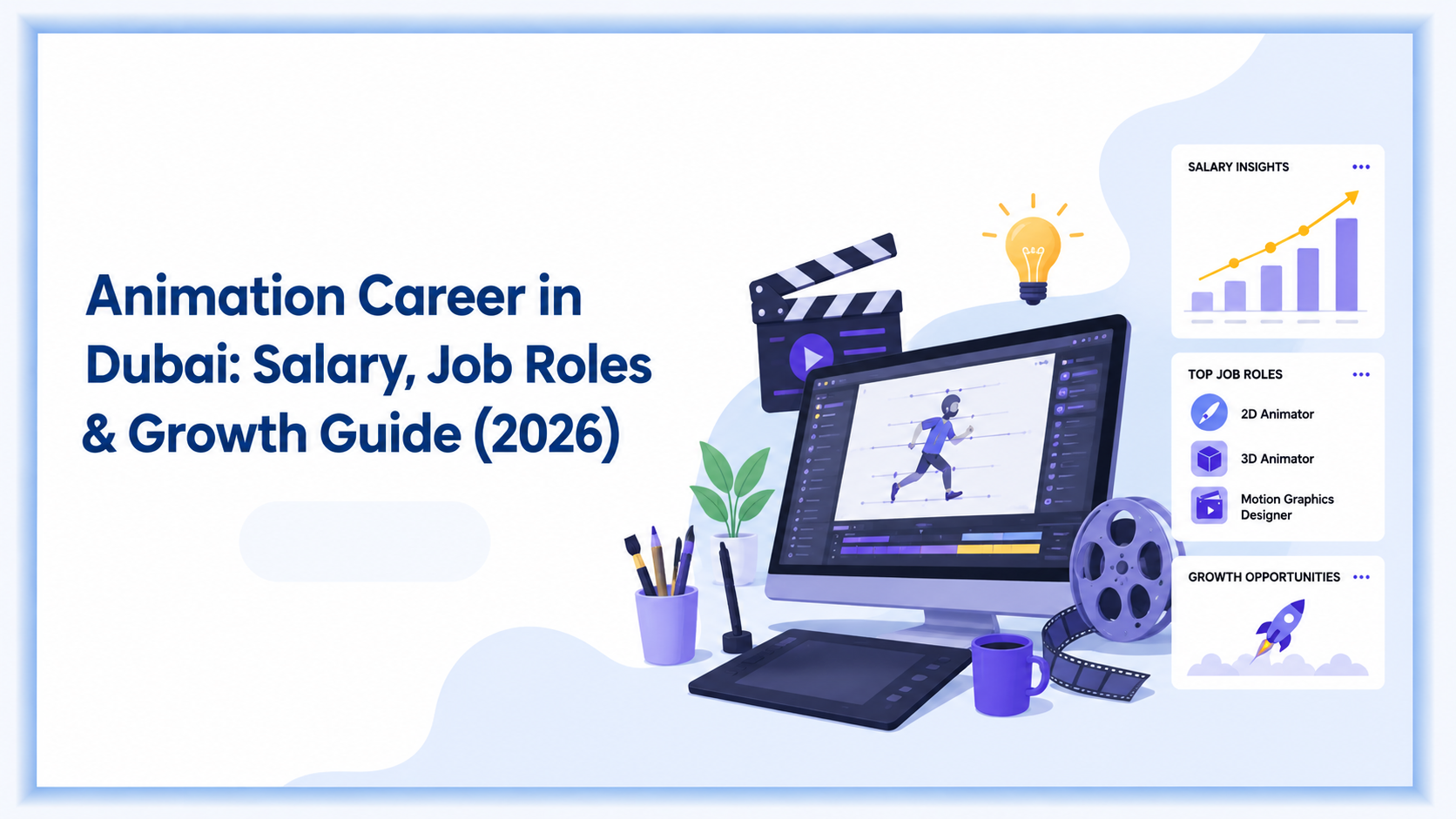
This guide looks at the animation jobs available in Dubai, expected salaries, skills employers want and the steps you can take to enter the field.
Is Animation a Good Career in Dubai Right Now?
Yes, animation is a very popular career today; however, it’s based on vision, not just certificates. An inclination towards creativity helps you work in industries such as advertising, marketing, media, events, gaming, real estate, retail, and technology. Each of these sectors uses animation differently. A marketing agency may need short motion graphics for social media. A real estate company may need 3D walkthroughs. A production studio may need VFX or character animation.
Currently, Dubai offers many such services. Employers are looking for people who can combine animation with video editing, graphic design, 3D, visual effects, and digital content. AI-assisted creative workflows are also gaining traction in content production.
That means the best career path may not be to learn “animation” as one broad skill.
You can instead make your decision based on your interests:
- Like typography, branding, and short videos? Motion graphics may suit you.
- Enjoy drawing and character movement? Consider becoming a 2D animator.
- Prefer modelling, lighting and realistic visuals? Look at 3D animation.
- Interested in films, effects and compositing? Explore VFX.
- Enjoy creating product or property visuals? 3D visualisation could be a better fit.
The field is competitive, but it is also broad, with opportunities across different industries in Dubai. Here, individuals have to rely on practical skills rather than qualifications alone.
Animator & Motion Graphics Designer Salary in Dubai (2026)
Naukrigulf reports an animator salary range of AED 3,000 to AED 12,000 per month in Dubai, with an average of AED 5,145 based on its available data. Glassdoor reports a base salary range of about AED 5,000 to AED 12,000 per month for motion graphics designers in Dubai.
Due to the creativity and scope of work, there is no set salary for an animator in Dubai. Pay changes with experience, specialisation, software knowledge, quality and the type of employer.
Current job advertisements provide another useful reference. For instance, one Dubai-based 3D animator role lists AED 6,000–6,500 per month. Here’s a tentative guide.
Experience / Specialisation | Indicative Monthly Salary |
Junior Animator | AED 4,000–7,000 |
Junior Motion Graphics Designer | AED 5,000–8,000 |
Mid-Level Animator | AED 7,000–12,000 |
Mid-Level Motion Graphics Designer | AED 8,000–15,000 |
Senior 3D Animator / Specialist | AED 10,000–18,000+ |
Senior Motion Graphics / VFX Professional | AED 12,000–20,000+ |
Top Animation Job Roles in Dubai
Job Role | What the Role Involves | Good Fit If You Enjoy |
2D Animator | Characters, illustrations, scenes and 2D movement | Drawing and storytelling |
3D Animator | Movement of 3D characters, objects and scenes | 3D worlds and realistic visuals |
Motion Graphics Designer | Animated text, graphics, ads and brand content | Design, typography and video |
VFX Artist | Visual effects, compositing and digital effects | Film and visual effects |
3D Artist | Modelling, texturing, lighting and rendering | Building digital objects and environments |
Character Animator | Character movement, expressions and acting | Character-based storytelling |
Game Artist | Characters, environments and game assets | Games and interactive media |
3D Visualiser | Realistic product, property or architectural visuals | Architecture and product design |
For example, a recent Dubai motion graphics role demands insight into After Effects, Adobe Creative Suite, animation principles, storytelling and visual design. It also lists 3D knowledge as a bonus.
A senior 3D role may expect experience with Maya, Cinema 4D or Blender, along with character animation, lighting, textures and visual effects.
This difference matters when choosing animation training Dubai. Your course should match the type of job you eventually want.
Top Industries Hiring Animators in Dubai
Animation skills can open opportunities across several industries.
Advertising and Marketing
Agencies need motion graphics for social media, advertisements, product launches, and brand campaigns. This one is among the most popular choices for motion graphics designers.
Real Estate
Dubai’s property market creates demand for 3D visualisation, walkthroughs, architectural animation and product-style property presentations.
Media and Entertainment
Production companies may hire animators, compositors and VFX professionals for films, television, events and digital content.
Gaming
Gaming studios use animation for characters, environments and visual effects. Animation jobs in the gaming industry can offer opportunities for skilled professionals.
Events and Experiential Media
Dubai’s events and experiential sector also creates demand for animation and motion graphics across large-scale installations, brand activations and immersive experiences.
Corporate and Digital Content
Companies increasingly create product videos, training content, presentations, explainers and social media assets in-house. This creates opportunities for people who can combine animation, editing and design.
What Skills Do Dubai Employers Look For in Animators?
The real skill lies in knowing how to use tools like After Effects and turn briefs into compelling end products.
- Animation fundamentals: Understand timing, movement, spacing, transitions and visual storytelling.
- Industry software: Learn tools that match your career path, such as After Effects and Premiere Pro for motion graphics or Blender, Maya and Cinema 4D for 3D.
- Design skills: Build a good eye for typography, layout, colour, composition and visual balance.
- Video editing: Learn to edit footage, add effects, create transitions and prepare content for different formats.
- 3D and VFX skills: For 3D animation jobs in Dubai, skills in modelling, texturing, lighting, rendering and compositing can give you an edge.
- Portfolio and showreel: Show your best work through a focused portfolio and showreel instead of simply listing software on your CV.
- AI-assisted workflows: Learn how AI tools can speed up parts of the creative process while keeping your own design and animation skills at the centre.
If you’re also exploring the role of video editing and motion graphics software, comparing Premiere Pro, After Effects and DaVinci Resolve can help you understand which tools fit different creative goals.
2D Animator vs 3D Animator — Quick Comparison
Still unsure which direction to take? This comparison can help.
Factor | 2D Animator | 3D Animator |
Main Work | 2D characters, graphics and scenes | 3D characters, objects and environments |
Common Tools | After Effects, Illustrator, Photoshop | Blender, Maya, Cinema 4D, 3ds Max |
Main Skills | Drawing, movement, timing, storytelling | Modelling, rigging, lighting, animation |
Common Industries | Advertising, education, social media, explainers | Gaming, VFX, real estate, film, product visuals |
Learning Curve | Easier starting point for many beginners | Usually more technical |
Career Direction | 2D Animator, Motion Designer | 3D Animator, 3D Artist, VFX Artist |
Best For | People who enjoy illustration and graphic storytelling | People who enjoy building and animating digital worlds |
Neither option is automatically better. If you enjoy drawing and visual storytelling, 2D may keep you more engaged. If you enjoy working with digital objects, cameras, lighting and realistic scenes, 3D may be a better fit.
If you’re considering a 3D career in Dubai, understanding how tools such as 3ds Max and Maya are used across different industries can also help you choose the right career path.
How to Start an Animation Career in Dubai
Step 1: Choose a career path
Start with 2D animation, 3D animation, motion graphics or VFX.
Step 2: Learn the right software
Focus on the tools used in your chosen field and learn them through practical work.
Step 3: Get practical training
A structured animation training program in Dubai can help you learn faster, practise regularly and build projects for your portfolio.
Step 4: Build a strong portfolio
Create five to eight good projects that show what you can do. Choose projects that match the roles you want.
Step 5: Create a focused showreel
Lead with your best work and keep the reel relevant to the job. For Motion Graphics Designer jobs in Dubai, focus on motion, video and graphic animation rather than unrelated design work.
Step 6: Search for the right roles
Look beyond “animator”. Search for 2D Animator, 3D Animator, Motion Graphics Designer, VFX Artist, 3D Artist, Video Editor and Animator, 3D Visualiser and Game Artist to find relevant animation jobs in Dubai.
If you want structured learning, explore DG Training & Development Institute’s Animation Training Course in Dubai to build practical skills and create work you can present to employers.
Conclusion
An animation career is an excellent choice for creatives who wish to work in visual storytelling formats. DG Training offers opportunities to learn motion graphics, 2D and 3D animation, VFX, gaming and visualisation.
It is a field where portfolio matters more than certificates. But the right certificate can fine-tune your skills and give you the edge needed to showcase your talent. If you enjoy 2D, 3D, motion graphics or VFX, start with the type of work you genuinely enjoy.
If you’re focusing on motion graphics and visual effects, learning After Effects can help you build the skills used in many animation workflows.
Yes. Dubai has opportunities across advertising, marketing, media, gaming, real estate, events and digital content. However, employers increasingly expect practical skills, strong portfolios and the ability to work across different types of content.
An animator salary in Dubai can vary widely. Current market data and job listings suggest junior roles may start around AED 4,000–7,000 per month, while experienced specialists can earn AED 10,000–18,000 or more. Actual pay depends on experience, employer, specialisation and portfolio quality.
Yes. 3D animation jobs in Dubai can be found across real estate, gaming, advertising, events, media and product visualisation. Employers may look for skills in Blender, Maya, Cinema 4D, 3ds Max, modelling, lighting, rendering and animation.
A motion graphics designer creates animated graphics, text, illustrations, transitions and visual effects for videos, advertisements, social media and digital platforms. Many Dubai roles also combine motion graphics with video editing.
It depends on your interests. A 2D animator may work more with illustration, characters and graphic storytelling. A 3D animator may work with modelling, lighting, environments, products or characters. Both can lead to careers in Dubai.
For motion graphics, After Effects and Premiere Pro are useful starting points. For 3D, employers may ask for Blender, Maya, Cinema 4D or 3ds Max. The right choice depends on the role you want. Current Dubai vacancies mention several of these tools.
Not necessarily. A degree can help, but practical ability matters. Employers commonly ask for a portfolio or showreel that demonstrates your animation and design skills.
Training can give you the technical foundation, but getting hired depends on what you can produce. Build a strong portfolio, practise on real projects and apply for roles that match your skill level.
If you want structured learning, you can explore DG Training & Development Institute’s Animation Training Course in Dubai and choose a learning path based on your career goals.